
The Real Reason Mineral Owners Undersell — And How to Protect Your Assets
It gets under my skin every time.
But before diving into why this happens, let me share a story that might sound familiar.
The Phone Call That Changed Everything
I recently received a call from a mineral owner interested in our Retrospective Appraisal services. During our conversation, I learned they already sold their inherited mineral rights—for far less than they should have. This sparked an important realization: so many mineral owners don’t understand what they’re sitting on, and unfortunately, mineral buyers know it.
Understanding Retrospective Appraisals
Before we explore why mineral owners fall for low offers, let me explain an important tool that can protect you: a Retrospective Appraisal.
What is a Retrospective Appraisal?
A Retrospective Appraisal is an engineering-backed valuation of your mineral and royalty assets as of the date they were inherited (the original owner’s date of death). This number—your stepped-up basis—can be wildly different from the price you later sell oil royalties or mineral rights for.
Here’s the critical part: this basis value is usually dramatically different from the value you ultimately sell them for.
This appraisal is performed by a licensed Petroleum or Reservoir Engineer, similar to a formal mineral rights appraisal, and it determines your mineral rights value at inheritance.
Why Is a Retrospective Appraisal Necessary?
Because when you sell mineral rights, Uncle Sam wants his cut—and your accountant will ask for your stepped-up basis.
Here’s the part most people (even accountants!) get wrong:
Your tax basis is the value of the interests when you inherited them, NOT the price you just sold them for.
This mistake alone can cost royalty owners tens—or even hundreds—of thousands of dollars.

Why This Distinction Matters (A Lot)
Maria inherited her family’s mineral interests on January 1, 2000 and sold them five years later on January 1, 2025 for $500,000. If she tells her accountant the sale price was $500,000, she’ll pay taxes at ordinary income rates—up to 37%—resulting in a $185,000 tax bill.
But here’s where it gets interesting. When Maria worked with Venergy Momentum to complete a Retrospective Appraisal, we discovered her minerals were worth $400,000 at the time of inheritance in 2000. Since she owned them for over a year before selling, she qualifies for long-term capital gains rates (approximately 20%). Now she only pays taxes on the $100,000 difference between $400,000 and $500,000—resulting in just a $20,000 tax obligation.
$185,000 or $20,000?
That’s a $165,000 difference. Obviously, Maria would rather pay $20,000.
Bonus Opportunity: The 1031 Exchange
And here’s even better news—Maria could further delay her tax payment entirely by taking advantage of a 1031 Exchange. Since mineral interests are considered real property, she can defer her taxes by reinvesting in other mineral assets or real estate. This strategy can be a game-changer for mineral owners looking to maximize their wealth.
Learn more about 1031 Exchanges and how you can defer your taxes here.
Now Back to the Phone Call… and Why Owners Fall For “High” Offers
Once I explained the importance of the Retrospective Appraisal, I asked the mineral owner what they sold their assets for.
And boom—there it was.
A shockingly low price.
The kind that makes me sigh and say:
“Man, I wish I could have sold this for you.”
After decades working with oil and gas companies, mineral rights buyers, and royalty owners, I’ve learned exactly who falls for these offers—and why.
Do you recognize yourself?
The Unknowing Heir
These mineral owners never knew they owned minerals in the first place. Then one day, their phone rings. A mineral buyer says something like: “We’ve been reviewing title records and determined that you and your siblings own mineral interests in [county, state]. We’re prepared to offer you $xxx,xxx.”
Since they never knew these assets existed and are suddenly being offered more money than they’ve ever seen at one time, they jump at the offer without question. (And here’s the really concerning part: that buyer might have located suspense account funds—money rightfully owed to the owners—and is essentially acquiring your minerals for free while “helping” you access that money.)
The Teeny-Tiny Royalty Payment Receiver
Maybe you’re getting $20 here, $60 there—sometimes for months, sometimes for years.
Then a buyer offers you thousands (or more!) to sell mineral rights.
It feels huge compared to your check size—but not compared to your asset value. The Teeny-Tiny Royalty Payment Receiver never questions:
- Why is the buyer suddenly interested?
- What is the true mineral rights value?
- Could the offer be way below market?
🚨 Spoiler alert: it usually is.
The Absent Owner
If your minerals are in Texas, but you’re in New York, it’s easy to think:
“If someone wants them, I might as well sell.”
These mineral owners live far from where their mineral rights are located. Out of sight, out of mind, they don’t feel connected to the asset. When someone offers to buy it, they think, “Why not? At least I’ll get something instead of keeping these forgotten mineral interests.”
This mindset costs owners more money than you’d believe.
The Uninformed Owner
They don’t know which county their minerals are in (or how to pronounce it), how much they own, or don’t know if their interest is mineral, royalty, NPRI, override, etc. Without this info, you can’t use a mineral rights calculator—or make an informed decision. This lack of knowledge leaves them vulnerable to manipulation and misunderstanding during negotiations.
The Elderly Owner
Retirees on fixed incomes who’ve held their mineral interests for decades are especially susceptible to being taken advantage of. A substantial offer suddenly feels like it could set them up for life—even though in most cases, it won’t. These mineral owners deserve better, and they deserve professional guidance.
The Inheritor in the Dark
Individuals who inherited mineral rights face a unique challenge: they don’t know how to manage minerals and royalties, and finding reliable information online is nearly impossible. Even AI tools like ChatGPT can’t provide situation-specific guidance for selling inherited mineral rights. This information gap makes them prime targets for low offers.
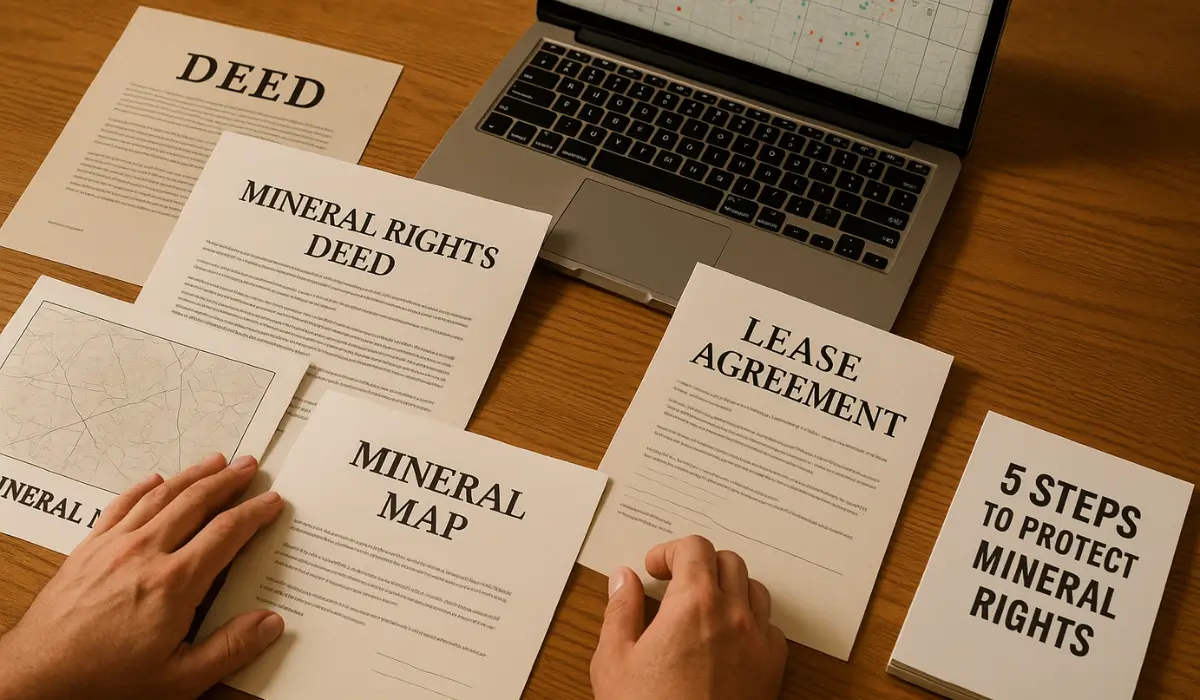
Our Expert Advice: 5 Essential Steps to Protect Your Mineral Rights
Step 1: Never Rush Into a Deal
This is the most important rule. When mineral buyers contact you with an offer, resist the urge to accept immediately. Buyers use a specific tactic: they bait you with an attractive initial offer. But once you share details about your mineral interests and they investigate further, they’ll often come back with a lower offer, claiming they’ve discovered problems with the title or the property.
Never sign or commit to anything without understanding exactly what you own.
Step 2: Gather Your Documentation
Collect every document you have related to your minerals:
- Conveyance documents (deeds and assignments)
- Lease agreements
- Division orders
- Revenue statements and check stubs
- Wills and affidavits of heirship
If you don’t have these documents a professional Landman can research them through county records, though this will cost more and take longer but it’s worth the investment.
Step 3: Stay Informed About Your Area
Learn about operator and permit activity in the area where your mineral interests are located. Track drilling activity, well production, and development plans. The more you understand about what’s happening around your minerals, the better prepared you’ll be when mineral buyers contact you. A good Landman will know how to find out this information for you. At Venergy, we can not only share this information with you, but we can teach you how to find it yourself.
The more you know, the harder it is for buyers to lowball you.
Step 4: Challenge the Outdated Wisdom
Forget the old saying: “Never sell your mineral rights and royalty interests.”
With modern drilling technology and increasing drilling density, this advice is outdated.
What’s actually true?
Never sell your minerals and royalties when they’re not worth anything.
The real question isn’t whether to sell—it’s when to sell at the right price.
Check out our most popular blog, Selling Mineral Rights: Key Stages and Timing for Maximum Profit.
Step 5: Hire a Professional
Talk to a respected professional Landman who specializes in selling minerals and has a solid reputation in the industry. They’ll understand market values, can negotiate on your behalf, and will help you avoid costly mistakes.
This is not a DIY project. It’s one area where professional guidance pays for itself many times over.
The Reality: Oil and Gas Wells Don't Last Forever
Here’s a hard truth: treat your mineral and royalty interests as an investment, not a family heirloom.
These are assets with a finite lifespan. Wells deplete over time. Production declines. Eventually, wells run dry entirely. When that happens, the mineral value decreases exponentially.
You don’t want to be the last person holding an empty bag.
The best time to sell minerals is when they still have significant production ahead of them and genuine value. Waiting until you’ve spent all the flush production royalty money and production is in steep decline means you’re negotiating from a position of weakness.
Ready to Maximize Your Mineral Wealth?
If you’re considering whether to:
- Sell mineral rights
- Sell oil royalties
- Understand your royalty interest
- Get a mineral rights appraisal
- Navigate offers from mineral rights buyers
- Or simply want clarity on your mineral rights Texas assets
- Sell mineral rights
I’m here to help mineral owners like you make informed decisions about your mineral interests and royalty payments. You’ve worked hard to build your family’s wealth; let’s make sure you’re getting fair value.
Your minerals deserve the attention of someone who understands their true value.




Leave a Comment