

👉 Ready to evaluate your options? Schedule a Consultation
Should I Sell My Minerals and Royalties?
“Should I sell my minerals and royalties?” This is a question I get asked very often.
Most of the time, clients want to know because they have started to receive offers for mineral rights or increasing values from mineral buyers. For others, the reasons vary:
- They may need or want to sell for personal reasons.
- They have held their assets for a long time and are starting to reconsider.
- They may simply be curious of what mineral price offers they could receive.
Many families receiving inherited acreage for the first time seek guidance related to inherited minerals and royalties before making long-term decisions.
Unfortunately, there’s no simple answer. Your mineral rights’ value—and the right time to sell—depends largely, but not solely, on the stage of oil and gas development your interests are in.
At every milestone development, there is a time to sell and a time to wait.
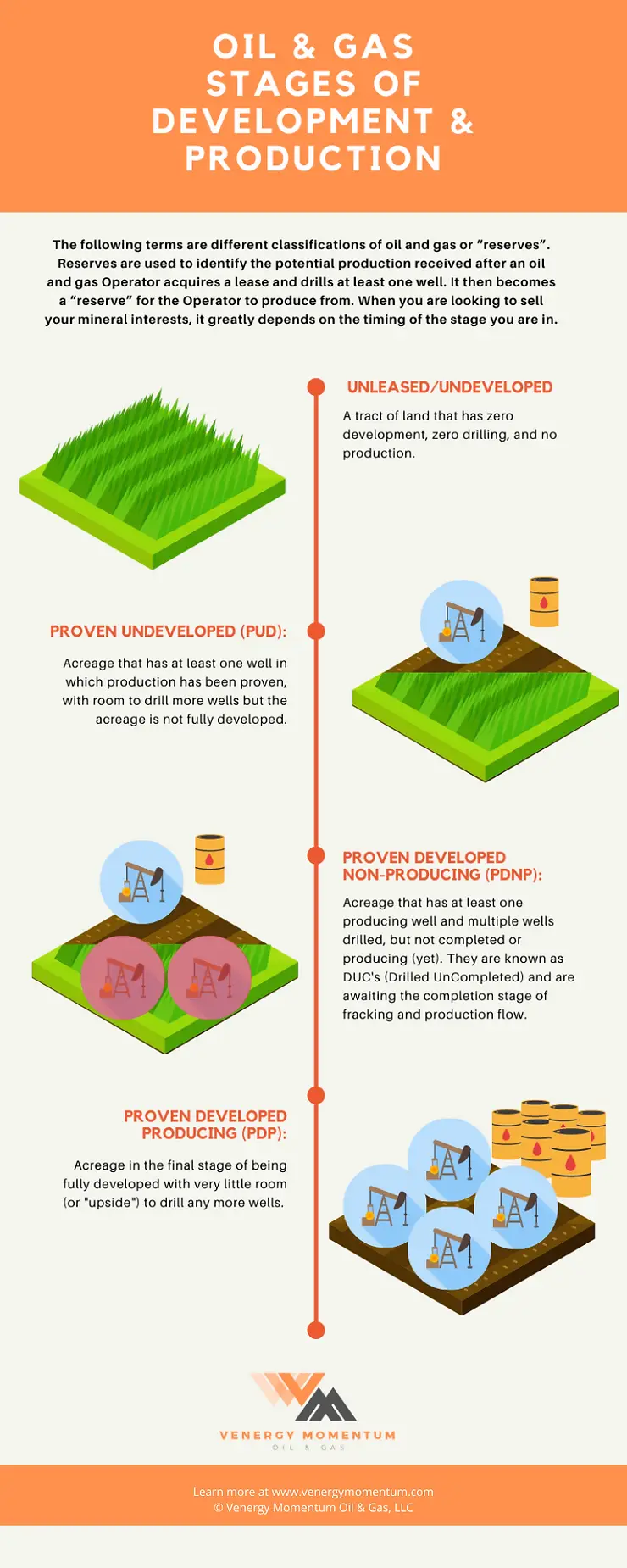
In this blog, we will walk through the key stages of oil and gas lease development:
- Unleased/Undeveloped
- Proven Undeveloped (PUD)
- Proven Developed Non-Producing (PDNP)
- Proven Developed Producing (PDP)
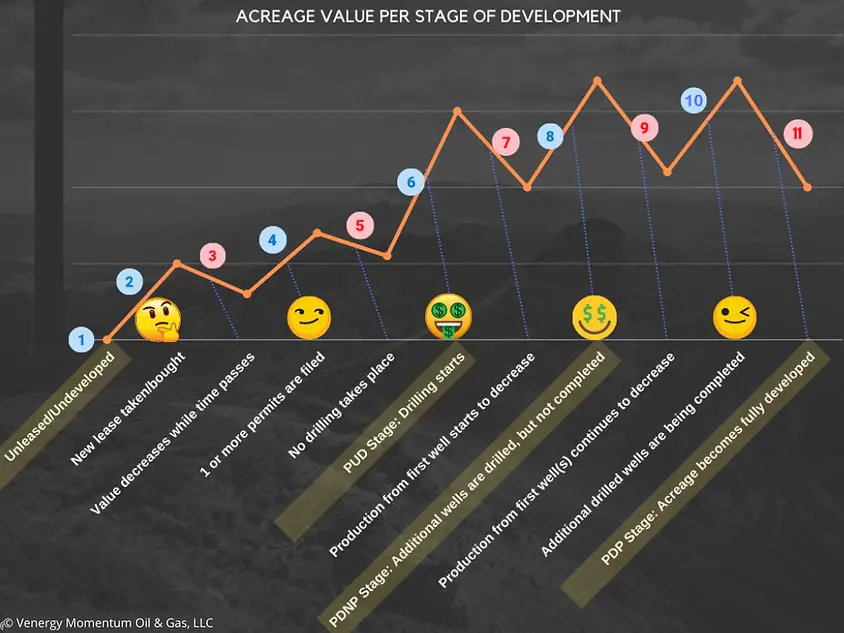
🏞 Stage 1 – Unleased/Undeveloped
Activity: No lease. No drilling. No production.
Unless oil and gas leasing and drilling activity is moving your way, it’s best to sit back and be patient. Selling now would bring minimal value since the minerals aren’t generating income. You’re also not being taxed on them if they aren’t being developed.
Watch our short video: Mineral Rights and Your Taxes.
Investor Insight: For long-term investors, this can be a good time to buy mineral rights—if the area shows potential.
Is this a good time to sell? No. This is likely the least opportune time.
✍️ Stage 2 – New Lease Taken or Bought
When a lease is taken (or bought) by an Operator, the value of mineral rights increases slightly. Lease terms become critical:
- Lease duration: Shorter leases often mean development is near.
- Royalty percentage: Should be between 20-25% with emphasis on the latter and cost-free.
- Clauses: Drilling commitments, pooling, Pugh clauses, and extension terms.
If development stalls, value possibly declines as lease expiration approaches. It will depend on the situation; be sure to discuss it with us.
Is this a good time to sell? This is the first milestone to consider, but still not optimal.
📝 Stage 3 – Value Decreases While Time Passes
If no drilling or additional leasing occurs, value declines steadily.
Is this a good time to sell? No. It’s best to wait for new drilling permits or activity.
📝 Stage 4 – One or More Permits Filed
👉 Curious what your minerals are worth? Schedule a Consultation With Us
An Operator files a permit, increasing value. More permits add more value. Permits on adjacent lands can also boost worth.
If no drilling occurs within a year, permits expire and value declines. This activity must be watched carefully. Drilling permits and operator activity can be tracked through agencies such as the Texas Railroad Commission.
Experienced oil and gas consulting can help owners monitor permit activity, operator movement, and nearby development that may impact value.
Is this a good time to sell? Yes—consider selling a percentage, but the best time is still ahead.
🛑 Stage 5 – No Drilling / Permit Expiration
If no drilling occurs, permits expire and value steadily decreases.
Is this a good time to sell? No, it’s best to wait to see what happens.
🛠 Stage 6 – PUD Stage: Drilling Starts
Drilling significantly increases value. Your acreage enters the Proven Undeveloped (PUD) and Proven Developed Producing (PDP) stages.
- Buyers are cautious about paying for PUD unless expectations are reasonable.
- Buyers love flush production (PDP).
Tip: Sell a percentage and seek the highest price possible with professional guidance.
Owners evaluating whether to sell mineral and royalty interests often begin seriously considering offers once drilling activity starts accelerating.
Is this a good time to sell? Yes—this can be one of the best opportunities.
👉 Considering selling part of your mineral interests? Schedule a Consultation
📉 Stage 7 – Production Declines
As initial wells decline, so does value. Buyers become cautious. Oil and gas production trends, commodity pricing, and long-term energy market data are tracked extensively through the U.S. Energy Information Administration.
Is this a good time to sell? Possibly, but earlier would have brought better offers.
A large number of owners wait too long to evaluate offers and end up learning the hard way why mineral owners often accept far less than they should.
🔧 Stage 8 – PDNP Stage: Additional Wells Drilled, Not Completed
👉 Need expert advice before making a move? Talk to a Landman
When Operators drill multiple wells but only complete a few these are called DUC’s – Drilled, Uncompleted Wells. Value can drop if remaining wells are delayed.
Is this a good time to sell? Yes—selling a percentage is still viable, though earlier would have yielded better value.
📉 Stage 9 – Production Continues to Decline
As production declines further, value continues to decrease.
Most unconventional shale wells experience steep early decline curves before stabilizing over time, which is one reason buyer pricing often softens during later development stages. Research published by the Institute for Energy Economics and Financial Analysis (IEEFA) further discusses how production decline impacts long-term well economics.
Is this a good time to sell? Possibly, but offers will reflect reduced production.
🔨 Stage 10 – Additional Drilled Wells Completed
Operators complete remaining DUCs, increasing value depending on the number and performance of new wells.
Is this a good time to sell? Yes, but buyer offers may not match seller expectations due to production history and depletion from previous wells. Sometimes new wells don’t yield the same results as former wells drilled.
🏭 Stage 11 – PDP Stage: Fully Developed
The acreage reaches full development. As production declines, so does value. Buyers and sellers often have differing expectations.
👉 Read our blog on the critical information sellers need to understand about mineral buyers’ offers.
Is this a good time to sell? Yes, but offers will reflect declining production.
Wrapping Up
At no point during declining stages is it typically wise to sell. Instead, wait for important milestones.
It’s vital for sellers to understand the stage your interests are in to set realistic expectations. Owners who spend time preparing their minerals before going to market are often in a much stronger negotiating position once buyer interest increases.
Final Thoughts
Owning mineral and royalty interests comes with responsibility. Avoid emotional attachment—selling may be wise to:
- Fund education.
- Prevent financial hardship.
- Protect assets.
- Implement a tax strategy, like a 1031 exchange into other investment properties of equal or greater value.
Understanding the true value of your mineral and royalty interests before making a decision can help owners avoid unrealistic expectations during negotiations.
Everyone’s situation is different.
A trusted landman familiar with the selling of mineral rights and royalties with an extensive END-BUYER network can help secure top dollar and manage the process smoothly.
👉 Ready to take the next step? Contact Us Today
Thank you for sticking with me. My goal is to help mineral and royalty owners make smart and confident decisions and to keep them from being taken advantage of. I’ve seen it too many times in my career, which is why I started my own company in 2014 to be an advocate for mineral and royalty owners.
Mineral and royalty ownership can be complicated, but we’re here to help.
Contact us today and visit our FAQ page to learn more.

Contact Venergy, We Can Help
The key is to work with a trusted professional who understands the mineral rights market, knows the companies that buy mineral rights, and has proven experience securing competitive offers for their clients.


