
What Mineral Owners Should Know Before Selling Mineral Rights
Many mineral owners eventually ask the same question:
“Should I sell my mineral rights?”
It’s a fair question — and one I hear all the time.
In fact, I recently spoke with a mineral owner who has been receiving several offers to buy her mineral rights.
If you’ve owned minerals for any length of time, you’ve probably seen these letters before. They tend to show up like clockwork.
Sometimes it feels like the moment a well gets drilled somewhere within driving distance, the mailbox starts filling up!
One of the offers she received looked pretty good. In fact, it looked really good.
Naturally she asked me:
“Is this a good deal, or am I leaving money on the table?”
The truth is, selling mineral rights can be a major financial decision. But many mineral owners don’t realize something important:
Timing can dramatically affect what buyers are willing to pay.
Two people can own minerals in the same county, and even as close as the next section over-contiguous acreage, and receive very different offers.
And buyers know this.
In fact, many mineral buyers spend their entire careers studying drilling activity, development timelines, and production data. Most mineral owners, understandably, do not.
That’s why understanding where your minerals sit in the development timeline can make a big difference when evaluating an offer.
If you’ve been receiving letters in the mail or wondering whether now is the right time to sell, it helps to understand how the process of selling mineral rights in the United States typically works.
Should I Sell My Mineral Rights?
The answer depends on several factors, including:
- The development stage of your acreage
- Whether drilling activity is moving toward your area
- How much interest you actually own
- The number of buyers interested in your region
Minerals that are closer to drilling or early production often receive stronger offers than undeveloped acreage. Understanding where your minerals sit in the development cycle can help you evaluate whether selling makes sense.
Quick Take for Mineral Owners
If you’re wondering whether you should sell your mineral rights, the answer often depends on a few key factors:
1. The development stage of your acreage
2. Whether drilling activity is moving toward your area
3. How much interest you actually own
4. How many buyers are competing for minerals nearby
Two mineral owners in the same county can receive very different offers depending on these factors.
Understanding where your minerals sit in the development cycle can help you decide whether an offer deserves serious consideration.
Why Timing Matters When Selling Mineral Rights
One of the biggest factors affecting mineral value is where your acreage sits in the development lifecycle.
As activity increases in an area, the uncertainty around production decreases. And when uncertainty decreases, buyers often become more aggressive.
In other words, the closer your minerals are to actual production, the more confidence buyers have in the future income those minerals may generate.
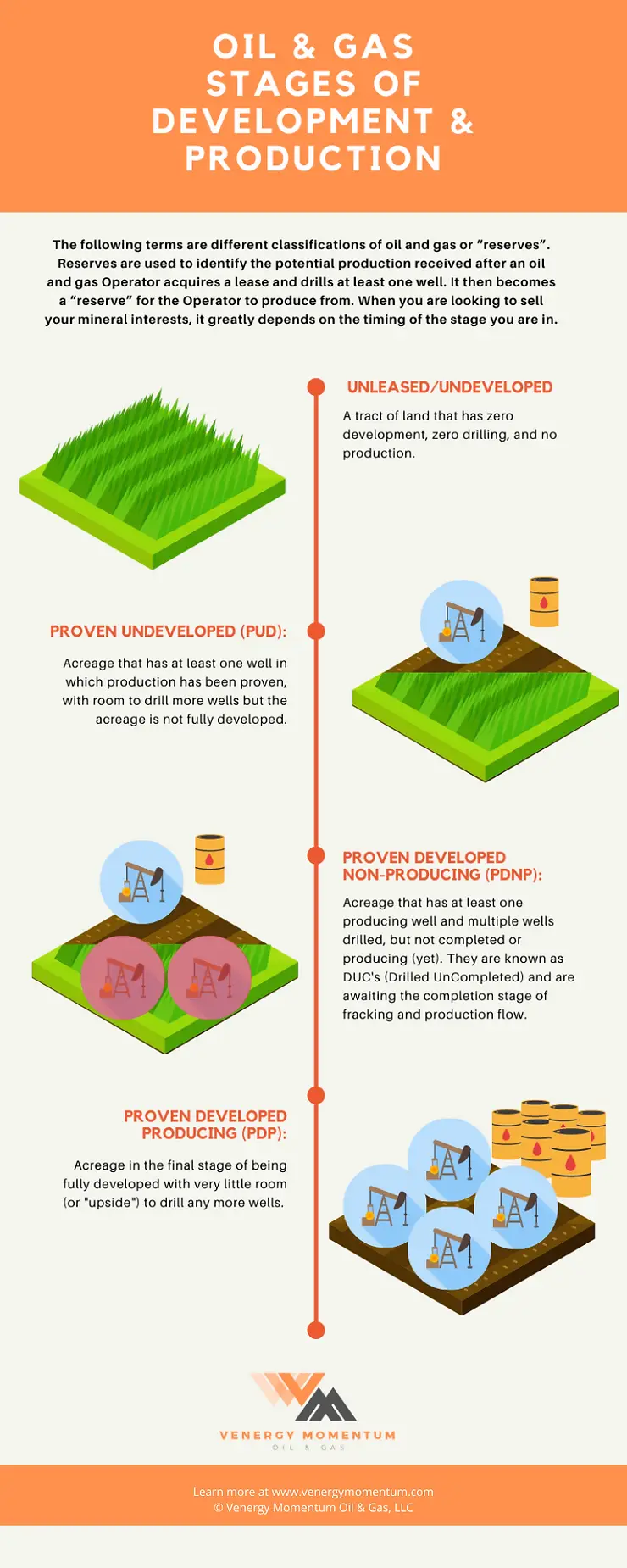
Let’s walk through the different stages and how they can affect value.

The 5 Development Stages That Affect Mineral Value
Stage 1: Unleased or Undeveloped Minerals
When minerals are unleased, it means no operator currently has the right to drill.
At this stage there may be:
- No lease agreements
- No permits filed
- No drilling plans
From a buyer’s perspective, that’s a lot of uncertainty.
And uncertainty is something buyers tend to price… very conservatively, or maybe not at all.
Some investors will still purchase undeveloped minerals based on geological potential or nearby activity. But in many cases, offers remain relatively low until something changes.
Think of it this way:
Buying undeveloped minerals is a bit like buying land hoping a highway might run through it someday.
It might happen — but until there’s evidence it will, buyers tend to proceed cautiously.
Stage 2: Lease Taken
When an operator leases your minerals, things start to get more interesting.
A lease establishes the terms under which drilling could happen, including:
- Your royalty percentage
- The length of the lease
- Development obligations
- Cost deductions
In competitive areas, royalty percentages often range between 20% and 25%.
Once minerals are leased, buyers have more information to work with, which can improve offers.
But leasing alone doesn’t guarantee drilling. If the lease sits for years without activity, buyers may become cautious again.
Leasing is a step forward — but drilling is usually what drives stronger offers.
Stage 3: Permit Filed
When drilling permits are filed, things start to change quickly.
Permits signal that an operator may be preparing to drill a well. That reduces uncertainty and increases the probability of future production.
Because of that, buyers often become more interested when permits appear in an area.
In many cases, mineral owners start seeing more offers during this stage.
However, permits can expire if drilling doesn’t occur within a certain timeframe. If that happens, excitement can fade and offers may soften again.
Stage 4: Drilling Begins
When drilling actually begins, the situation changes dramatically.
This is when potential production turns into something real.
Many shale wells produce a large portion of their lifetime production during the first few years. Because of that early “flush production”, buyers often pay close attention to this stage.
If early wells in an area perform well, competition among buyers can increase.
Some mineral owners choose to sell a portion of their minerals during this phase while keeping the rest for long-term income.
Stage 5: Production Decline
After wells have been producing for a while, production typically begins to decline.
With normal shale development, early production in modern day horizontal wells tends to start out very strong and then enters a very steep decline. The output will then gradually decrease over time and the production and revenue begin to level out.
While royalty checks may still look meaningful, buyers usually focus on future production, not past performance.
Once production declines and drilling opportunities are limited, offers will start to decrease.
At this stage, decisions to sell are often based more on personal financial goals than on growth potential.
How Buyers Actually Value Mineral Rights
One thing many mineral owners are surprised to learn is that buyers aren’t simply guessing at what minerals might be worth.
There’s usually a significant amount of production and financial modeling involved.
Buyers try to estimate how much income the minerals might generate in the future and what that income might be worth today. In some cases, mineral owners seek a mineral rights appraisal to better understand how buyers may be evaluating their acreage.
In simple terms, they’re asking:
“If we buy this today, what will it likely pay over time, and how much can we make in 1-5 years?”
Of course, predicting oil and gas production isn’t an exact science.
If it were, every investor in the industry would be retired on a beach somewhere by now.
Instead, buyers rely on data, nearby well performance, and their expectations about future drilling.
Forget the old saying: “Never sell your mineral rights and royalty interests.”
With modern drilling technology and increasing drilling density, this advice is outdated.
What’s actually true?
Never sell your minerals and royalties when they’re not worth anything.
The real question isn’t whether to sell—it’s when to sell at the right price.
A Quick Reality Check About Mineral Offers
Here’s something many mineral owners don’t realize.
They know only a small percentage of owners will respond. And among those who respond, some will accept the first offer they receive.
That’s simply how the business works.
But mineral rights can represent a valuable long-term asset, and rushing into a sale without understanding what you own can sometimes lead to regret later.
Taking a little time to understand your minerals can make a meaningful difference.

Why Some Offers Are Higher Than Others
Mineral owners are often surprised when they receive very different offers from different buyers.
That happens because buyers don’t always value minerals the same way.
Some buyers may:
- Believe more wells will be drilled
- Have lower return requirements
- Be focusing on your specific area
- Or simply need to deploy capital quickly
In other words, two buyers may look at the same minerals and see two very different opportunities.
Which is why accepting the first offer that shows up in your mailbox can sometimes be like selling your house after talking to only one buyer.
You might still get a fair deal.
But you might also never know what someone else was willing to pay. It’s important to remember–value is found in the eye of the beholder. And everyone sees value differently, or at least most do.
Check out: Why Buyers and Sellers Disagree on Mineral and Royalty Value.
Preparing to Sell Your Mineral Rights
If you’re thinking about selling minerals, preparation can make a big difference.
Many owners speak with professionals who specialize in oil and gas consulting before responding to offers.
Important documents to gather for review by a professional include:
- Revenue statements
- Division orders
- Lease agreements
- Deeds or title documents
- Probate or trust documents if minerals were inherited
Providing these details early can help prevent delays and reduce uncertainty for buyers.
3 Questions Every Mineral Owner Should Ask Before Selling
Before accepting an offer to sell your minerals, it’s worth asking a few important questions:Taking a moment to answer these questions can help you approach offers with more clarity and confidence.
Before You Accept an Offer in the Mail
If you’re like many mineral owners, the first time you seriously consider selling is when an offer shows up in the mail.
Sometimes those offers look attractive.
Other times they create more questions than answers.
Either way, it’s important to remember something:
The first offer you receive is rarely the only offer that exists.
Understanding your minerals, the development activity nearby, and how buyers value acreage can help you make a more informed decision.
If You’d Like a Second Set of Eyes on an Offer
If you’ve received an offer to buy your mineral rights and you’re not sure whether it’s reasonable, it may help to have someone review it with you.
At Venergy Momentum, we work with mineral owners who want to understand what they own and what their options may be before making a decision.
You can also see what other mineral owners have shared with their 5-star Google reviews and client testimonials.
A quick conversation can often help clarify:
- where your minerals sit in the development cycle
- what activity may be happening nearby
- and how buyers may be evaluating your acreage
If you’d like to discuss your minerals or review an offer you’ve received, you can reach me at:
There’s no pressure — just a conversation to help you better understand your mineral interests.




Leave a Comment